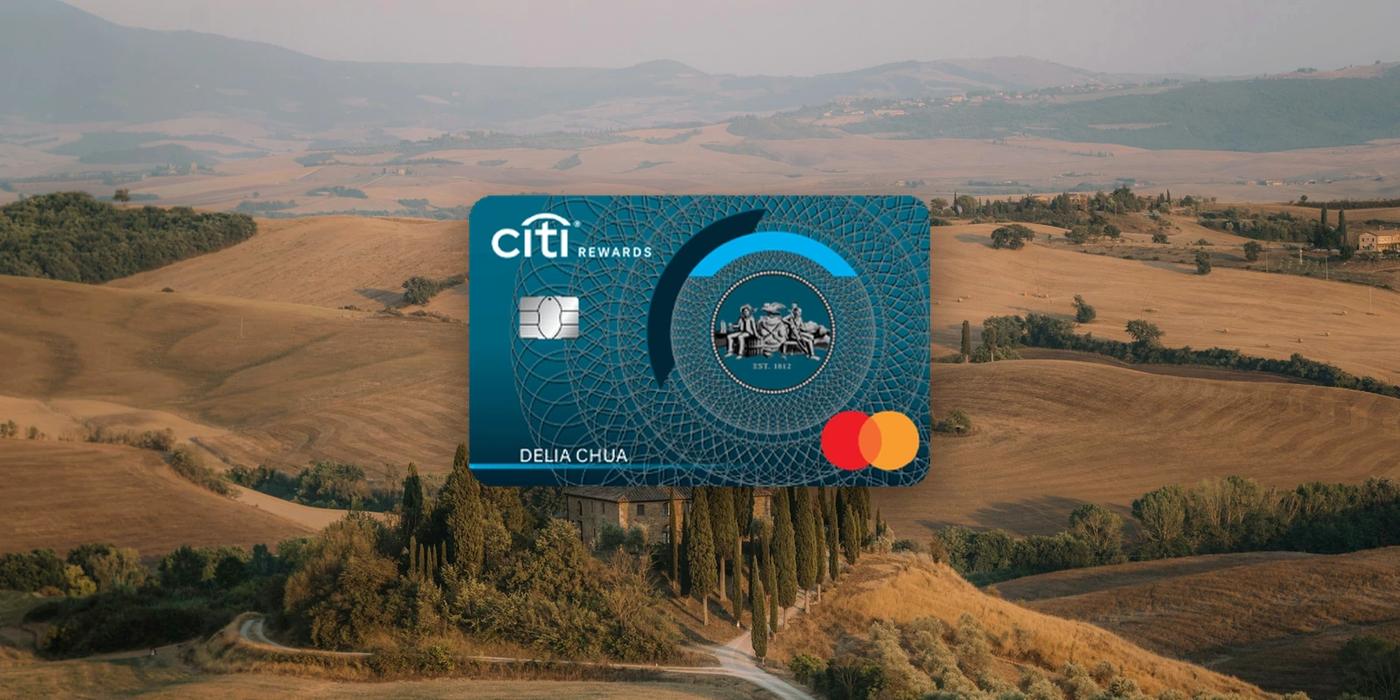
The default card for almost anything bought online, travel aside

| Min income | Base earn | Bonus earn | Monthly cap |
|---|---|---|---|
| S$30,000S$42,000 for foreigners | 0.4 mpdeverything else | 4 mpdonline, travel excluded | S$1,000about 9,000 bonus points |
| Annual fee | Transfer fee | Points expiry | Transfer blocks |
| S$196.20first year waived | S$27.25per transfer, not per year | 60 monthsfrom card approval | 10,000 miles25,000 points minimum |
While every other bank was busy inventing new ways for spend to not qualify, Citi kept the Rewards card gloriously stupid: if you bought it online, it earns. No online-or-contactless double condition, no MCC lottery on the everyday stuff, no tapping ritual to remember.
That one decision makes it the card most people actually use the most. It covers online groceries, which almost every other miles card in Singapore refuses to pay on, and it does not care whether you tapped, inserted or typed the number in.
The price of that simplicity is a S$27.25 transfer fee every time you move points out, and a travel category that earns nothing extra at all. Both are worth planning around rather than worrying about.
Annual Fee
S$196.20, waived the first year, and usually waived after that if you call and ask.
| Card | First year | Second year on |
|---|---|---|
| Principal card | Waived | S$196.20 |
| Supplementary card | Waived | S$98.10 |
The annual fee is negotiable. The S$27.25 per conversion is not, and that is the one to actually plan around. It lands every time you move points, so this is a card you sweep in one large block rather than trickle out whenever you remember. I let mine sit until there is a redemption in sight.
Welcome Bonus
Citi Rewards
Welcome bonus: pick one of 5
- S$400 Cash via PayNow
- S$660 The Morning coffee machine with 20 capsules
- 25,000 miles Max Miles by HeyMaxTransferable to airlines
- S$799 Dyson Airstrait straightener
- S$559 Dyson V8 Cyclone vacuum
Offer ends 2026-09-30
Welcome bonus
- 16,000 miles Bonus milesawarded as 40,000 Citi ThankYou PointsTransferable to airlines
Offer ends 2026-09-30
Sign-up rewards change often, so confirm the current offer before you apply. New customers only, meaning no card from Citibank in about the last 12 months.
Sign-up offers move monthly and almost always carry a "new to bank" condition, meaning no Citi card in the past 12 months.
How many miles do I earn?
4 miles per dollar on online spend and in-store shopping, up to S$1,000 a month between them. Everything else earns 0.4.
Citi writes this as 10X ThankYou points, and 2.5 points buy 1 mile, so 10X is 4 mpd. The 10X is what goes on the marketing. 4 mpd is what lands in your account.
| Spend type | Points | Miles per dollar | Cap |
|---|---|---|---|
| Online and in-store shopping, excluding travel | 10X | 4.0 | S$1,000 / month, shared |
| Everything else | 1X | 0.4 | Uncapped |
One rate, one condition, one cap. On most 4 mpd cards you have to satisfy a category and a payment method at once, which is how a restaurant that would have paid 4 mpd quietly pays 0.4 because you inserted the card. This one only asks whether it happened online.
One correction worth making, because this card is usually described as online-only and that is not the whole of it: Citi also pays 10X on in-store shopping, at department stores and clothing stores. The cap is shared rather than separate, so online and in-person spending draw on the same S$1,000, but it does mean a shopping trip earns the same 4 mpd as the same purchase made on your phone.
What spend actually counts for the bonus?
Almost anything bought online, plus shopping in person at department and clothing stores, with travel as the one large and deliberate exception.
The exclusion that matters is travel. Airlines, hotels, cruises and travel agencies all earn base rate, which is a strange gap on a card people reach for when booking flights, and the reason the next section exists.
| What you’re buying | Bonus? | The catch |
|---|---|---|
| 🛒 Online groceries | ✓ Yes | RedMart and FairPrice online count. The same basket in store does not |
| 🛍 Shopee, Lazada, Amazon | ✓ Yes | Straightforwardly online |
| 🍜 Food delivery | ✓ Yes | Ordered in an app, so it always qualifies |
| 🚕 Grab, TADA, Ryde | ✓ Yes | Charged in app |
| 📺 Streaming and subscriptions | ~ Maybe | MCC dependent; digital goods sometimes code outside the bonus |
| ✈ Flights and hotels booked direct | ✕ No | Travel is excluded from the 10X |
| 🧳 Anything through an OTA | ✕ No | Also travel, also excluded |
| 🏪 In-store retail | ✕ No | Citi’s in-store bonus is a separate, narrower thing |
Groceries are the quiet win here. Supermarkets are excluded from the bonus on nearly every Singapore miles card, the HSBC Revolution included. A S$600 monthly shop bought online earns 2,400 miles instead of 240. Switching one habit is worth more than most of the optimisation people spend evenings on.
The Travel Loophole (w/ Atome)
Travel earns base rate here, which stings. But paid through Atome’s three-instalment option, the charge hits your card as Atome rather than as the travel agent, which codes MCC 5999 and is not on Citi’s exclusion list.
The instalments also land across three different months, so one big booking stops eating a single month’s cap. On S$3,000 that is the gap between 1,200 miles and roughly 12,000.
| Route | How it codes | Miles on S$3,000 |
|---|---|---|
| Booked and paid directly | Travel, outside the bonus | 1,200 |
| Same booking via Atome, 3 instalments | MCC 5999, across three months | ~12,000 |

New to Atome? Signing up through my link gets you S$10 off your first purchase, claimable from their voucher centre. Bills split into three, 0 percent interest.
Banks close these doors without notice: the same move already stopped working on UOB cards, and Citi could add Atome to its exclusion list tomorrow.
The overseas one: Amaze still links here
What Amaze actually is, since it gets thrown around as jargon: a free card from Instarem that sits in front of your real one. You link a credit card to it, pay with the Amaze card, and Amaze bills your linked card behind the scenes. Your bank never sees the merchant, it only sees Amaze.
That indirection is the whole trick. An overseas purchase routed through Amaze arrives on your card as a local online transaction in SGD, which is precisely the shape the 10X bucket is looking for. The merchant was in Tokyo; as far as Citi is concerned you bought something online in Singapore.
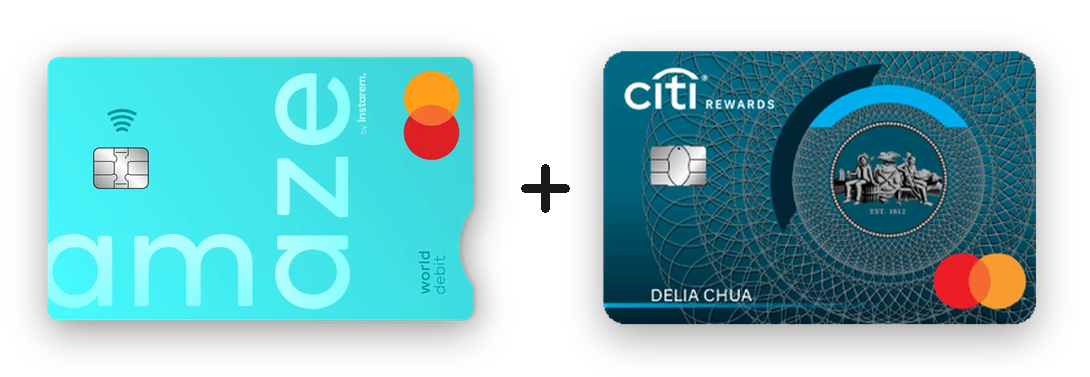
Worth knowing because it is genuinely rare: Citi Mastercards are the only cards in this series that still link to Amaze. Every DBS, POSB and UOB card was blocked years ago.
| Route | Roughly what it costs | Miles |
|---|---|---|
| Direct on a 4 mpd FCY card | about S$32.50 in FCY fees | 4,000 |
| Via Amaze on this card | about S$20 in embedded FX | 4,000 |
The version of this that died is worth flagging, because it is still repeated. Amaze plus Citi Rewards used to be pitched as 4 mpd on everything in SGD. Instarem added a 1 percent fee on all SGD transactions in February 2025, so paying 1 percent to earn 4 mpd is now a bad trade locally. It only survives where you were paying an FX fee anyway.
Transfer Partners
Points last 60 months from card approval, which is unusually generous and takes the urgency out of a small balance. Transfers move in blocks of 10,000 miles, so the practical minimum is 25,000 points, roughly six months of a maxed cap.
| Programme | Points for 10,000 miles |
|---|---|
 Singapore Airlines KrisFlyer Singapore Airlines KrisFlyer | 25,000 |
 Qatar Privilege Club Qatar Privilege Club | 25,000 |
 Cathay Asia Miles Cathay Asia Miles | 25,000 |
 British Airways Avios British Airways Avios | 25,000 |
 Etihad Guest Etihad Guest | 25,000 |
 EVA Infinity MileageLands EVA Infinity MileageLands | 25,000 |
 Air France KLM Flying Blue Air France KLM Flying Blue | 25,000 |
 Qantas Frequent Flyer Qantas Frequent Flyer | 25,000 |
 Thai Royal Orchid Plus Thai Royal Orchid Plus | 25,000 |
 Turkish Miles&Smiles Turkish Miles&Smiles | 25,000 |
 IHG One Rewards IHG One Rewards | 25,000 |
No KrisFlyer penalty here, which is a real advantage over HSBC: the ratio is identical wherever the points go. The cost is that S$27.25, charged per conversion rather than per year.
How I actually use it. I let the balance build and move it once, usually when a redemption is already in sight. Citi also runs transfer bonuses more often than most, so sitting on points and waiting for one is often worth more than the fee costs. Mine usually goes to Qatar for exactly that reason, and because I would rather not have everything in one programme.
Before any redemption, always check the route you want is actually available. The worst thing you can do is diversify into another mileage program with no redemption in mind.
What should I pair it with?
Worked through on S$1,500 of online spend in one month:
| Spend | Rate | Miles |
|---|---|---|
| First S$1,000 | 4.0 mpd | 4,000 |
| Next S$500 | 0.4 mpd | 200 |
| Total | 2.8 mpd effective | 4,200 |
Move that S$500 to a second 4 mpd card and it pays 2,000 instead of 200. On a card this easy to max out, the second card matters more than any tweak to how you use this one.
Something that covers in-store spend and travel, because this card pays base on both.
Pairing advice is usually vague and it does not need to be, because these gaps are known and countable.
In-store is the real hole. Everything you buy in person earns 0.4 mpd here, and for most people that is a meaningful share of the month. This is the card you pair with a contactless earner, not another online one.
| The gap | What it costs you | What closes it |
|---|---|---|
| Spend past the S$1,000 cap | 0.4 mpd instead of 4 | Another 4 mpd card or a general spend card |
| Anything bought in person | 0.4 mpd on a lot of daily life | UOB Preferred Visa, HSBC Revolution |
| Travel booked anywhere | 0.4 mpd on your largest purchases | Atome, Maybank XL, UOB Ladies |

Build your miles card stack
One card never covers everything. Put in what you actually spend and see which cards to hold together, and what to put on each.
Build my stack→The verdict, restated
The least fussy 4 mpd card in the market, and the one with the widest set of workarounds that still work. Online groceries alone justify it for most households. Three things worth knowing on day one: the cap is S$1,000, travel earns nothing extra, and every transfer costs S$27.25, so move points in blocks.
Sources
Citi Rewards product page and Citi’s published exclusion list, effective 16 December 2024. Rates, fees and caps correct as of 5 August 2026. The monthly bonus cap is Citi’s official 9,000 bonus points figure; the full transfer partner list beyond KrisFlyer and Asia Miles is not confirmed. This guide shares my own experience for education, it is not financial advice, and card terms change: always verify with the bank before applying.