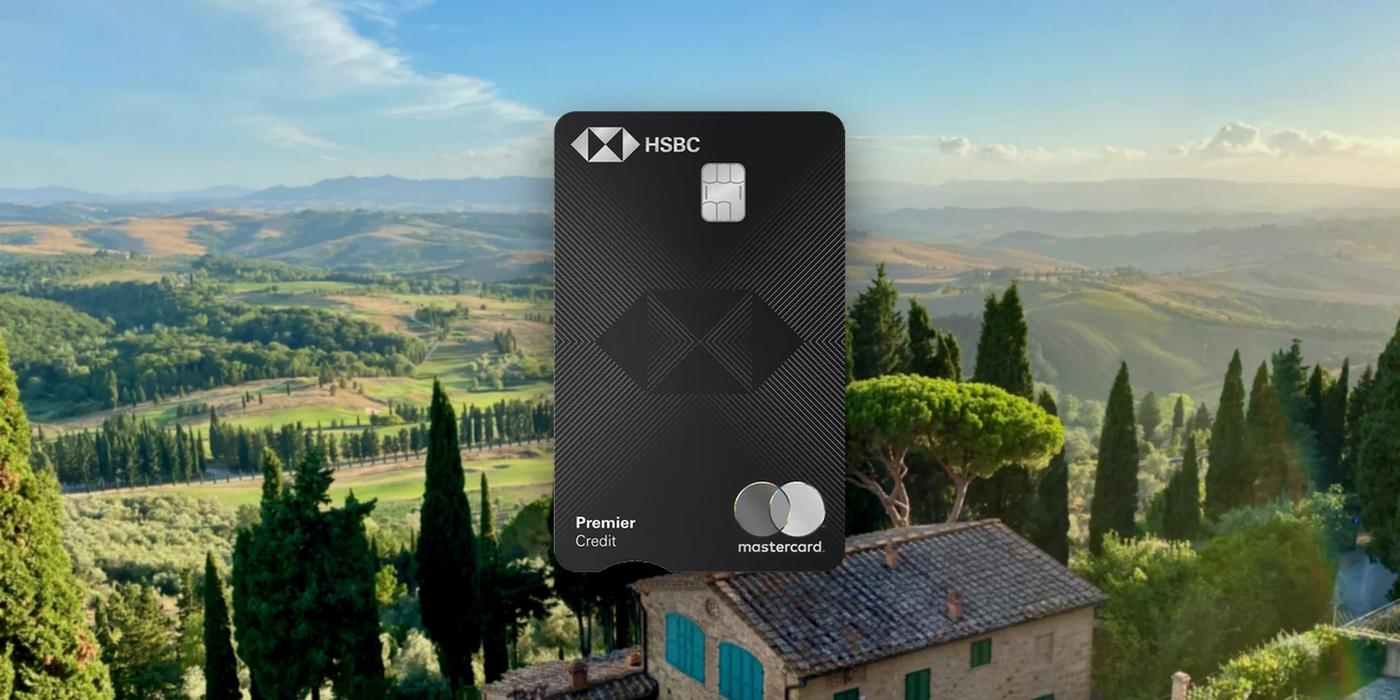
The highest general-spend rate here, if you can park S$200,000 with HSBC

| Min income | Real gate | Base earn | Overseas earn |
|---|---|---|---|
| S$30,000S$65,000 without the relationship | S$200,000total relationship balance | 1.68 mpdlocal, uncapped | 2.76 mpdforeign currency, uncapped |
| Into KrisFlyer | Annual fee | Monthly cap | Welcome offer |
| 1.4 and 2.3 mpdthe worse ratio | S$708.50waived while you are Premier | Noneon either rate | Up to 91,800 milesPremier Qualified |
At 1.68 miles per dollar on ordinary local spending, this is the highest general-spend rate of any card on this site. Not a bonus category, not a portal, not a promotion with an end date. Everything you buy, uncapped, at a rate that beats DBS Vantage at 1.5 and UOB PRVI at 1.4.
Which raises the obvious question of why it is not the answer to everything, and the answer is that you cannot simply apply for it. This card is sold to HSBC Premier customers, and Premier asks for a total relationship balance of S$200,000. Income alone does not qualify you at any level.
So the interesting number on this card is not the S$708.50 fee, which is waived for as long as you hold the relationship. It is the S$200,000, and what you could have done with it somewhere else.
Annual Fee
S$708.50, waived while you hold Premier status, and no amount of spending waives it otherwise.
| Card | First year | Second year on |
|---|---|---|
| Principal card | Waived | S$708.50 |
| While HSBC Premier | Waived | Waived |
This is the one card in the set where the fee is not the price. Every other premium card asks you to spend your way to a waiver or to pay and take miles back. This one waives the fee for everyone eligible to hold it, and charges S$708.50 only if your relationship lapses, which is less a fee than a penalty for leaving.
Read it as a subscription paid in deposits rather than dollars. S$200,000 sitting with HSBC has an opportunity cost, and whether this card is good value depends entirely on whether that money was going to sit there anyway. For someone already banking with HSBC at that level, the card is close to free and the rate is the best here. For someone moving money specifically to qualify, it is one of the most expensive cards in Singapore.
Welcome Bonus
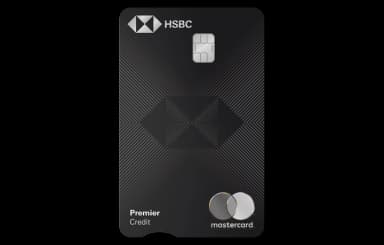
HSBC Premier Mastercard
Welcome bonus: all 2
- 58,200 miles Bonus milesawarded as 145,500 HSBC Reward pointsTransferable to airlines
- S$200 Reward voucher
Offer ends 2026-10-31
Sign-up rewards change often, so confirm the current offer before you apply. New customers only, meaning no card from HSBC in about the last 12 months.
The larger offer is for Premier Qualified applicants and the smaller one is not, so the same card advertises two very different welcome bonuses. Check which tier you are being offered before counting the miles.
How many miles do I earn?
1.68 miles per dollar on everything, 2.76 on foreign currency, with no cap and no minimum spend.
| Spend | Reward points | Best partners | KrisFlyer |
|---|---|---|---|
| Local, everything | 4.2 per S$1 | 1.68 mpd | 1.4 mpd |
| Foreign currency | 6.9 per S$1 | 2.76 mpd | 2.3 mpd |
Two numbers for one rate, and the gap is the thing to understand. HSBC charges 30,000 points for 10,000 KrisFlyer miles against 25,000 with its better partners, so every rate on this card is 20 per cent lower if KrisFlyer is where you always end up. That is not a quirk of this card, it is how HSBC prices the whole range.
Both figures are honest and the marketing tends to quote whichever is larger. This review leads with 1.68 because that is what the card pays at its best ratio, and states 1.4 beside it because that is what most Singaporeans will actually get.
What spend actually counts for the bonus?
The billing currency decides it, not where you are standing.
| Transaction | Bonus? | Earns |
|---|---|---|
| 💳 Charged in a foreign currency | ✓ Yes | 2.76 mpd, any channel, no cap |
| ✈️ Bought overseas but billed in SGD | ✕ No | Local rate only, 1.68 mpd |
| 🛒 Overseas website billing in SGD | ✕ No | Local rate only |
| 🏪 Local shop billing in a foreign currency | ✓ Yes | The higher rate |
This is where dynamic currency conversion costs you. When a terminal abroad offers to bill you in Singapore dollars, accepting it moves the transaction out of the 2.76 bucket and into the 1.68 one, on top of the poor exchange rate it applies. Always choose the local currency. It is the single most repeatable mistake on any card that pays a foreign-currency bonus, and on this one it costs over a mile per dollar.
The S$200,000 Door
Everything above assumes you can get the card, and this is the part worth being blunt about, because no earn rate matters if the door is shut.
| Who you are | Income needed | Also needed |
|---|---|---|
| Salaried citizen or PR, already Premier | S$30,000 | The S$200,000 balance |
| Self-employed, already Premier | S$40,000 | The S$200,000 balance |
| Everyone else | S$65,000 | Still the Premier relationship |
| Foreigner | S$65,000 | Whatever the balance |
The S$30,000 income line is the one that gets quoted, and on its own it is misleading. Income is necessary and never sufficient here. What actually admits you is the total relationship balance, and S$200,000 is a serious amount of money to hold in one place for a credit card.
If the balance is already there for other reasons, this is arguably the best-value card in Singapore: the top general-spend rate, uncapped, on a fee you never pay. If it is not, the honest comparison is not against other cards but against what S$200,000 earns elsewhere, and that is a question about your savings rather than your wallet.
Unlimited Lounge Access
The other half of what this card buys, and the part I get asked about most. HSBC's own wording is that the primary cardholder and up to three supplementary cardholders enjoy unlimited complimentary airport lounge visits across more than 1,700 destinations. Not four visits a year. Not twelve. Unlimited, for four people.
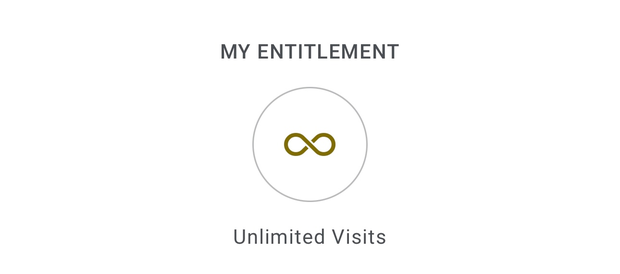
My own Priority Pass panel. The entitlement is an infinity symbol rather than a number, which is the whole point.
It is worth pausing on how unusual that is here. Citi Prestige gives twelve visits a year shared with guests, so a couple gets six. DBS Vantage gives ten, also shared. Citi PremierMiles gives two, principal only. This gives four people as many as they can physically use.
And Priority Pass is not only lounges. At a lot of airports the network includes restaurants, where a visit becomes a credit against your bill instead of a door you walk through, and at some it stretches to spa treatments, sleep pods and shower suites. Changi, Hong Kong, Heathrow and Sydney all have non-lounge options, so the benefit follows you into terminals where the actual lounge is a long walk from your gate.
Which invites an obvious and slightly stupid experiment, and I mean this affectionately: with a long enough layover you can simply do them all. Breakfast in one terminal, a shower and a nap in the second, a sit-down lunch you did not pay for in the third. Nobody needs four breakfasts. It is still very funny that the card does not stop you.
The one thing that does stop you: guests are USD35 each per visit, so the unlimited part covers cardholders and not the friend you are travelling with. If you travel as a pair regularly, the answer is a supplementary card rather than paying at the door, since three of those are included.
Transfer Partners
The same HSBC pool as Revolution and TravelOne: 16 airline programmes and 4 hotel ones, twenty in all, with transfers that are free at the time of writing.
| Programme | Points per 10,000 miles |
|---|---|
 Cathay Asia Miles Cathay Asia Miles | 25,000 |
 British Airways Avios British Airways Avios | 25,000 |
 EVA Infinity MileageLands EVA Infinity MileageLands | 25,000 |
 Air France KLM Flying Blue Air France KLM Flying Blue | 25,000 |
 Etihad Guest Etihad Guest | 25,000 |
 Qantas Frequent Flyer Qantas Frequent Flyer | 25,000 |
 Vietnam Airlines Lotusmiles Vietnam Airlines Lotusmiles | 25,000 |
 Singapore Airlines KrisFlyer Singapore Airlines KrisFlyer | 30,000 |
 Thai Royal Orchid Plus Thai Royal Orchid Plus | 30,000 |
 Qatar Privilege Club Qatar Privilege Club | 35,000 |
 Turkish Miles&Smiles Turkish Miles&Smiles | 35,000 |
 Air Canada Aeroplan Air Canada Aeroplan | 35,000 |
 JAL Mileage Bank JAL Mileage Bank | 50,000 |
Worth reading that table before deciding what the card earns. At 25,000 a block the rate is 1.68 and 2.76. At KrisFlyer's 30,000 it is 1.4 and 2.3. And at Japan Airlines' 50,000 it is 0.84 and 1.38, which is worse than a free card, so the destination matters more here than the spending does.
How I actually use it. I mostly do not transfer to KrisFlyer at all on HSBC points. Two routes I use instead, both at 25,000 rather than 30,000:
Avios, then Qatar. Points go to British Airways Avios, and Avios move 1:1 into Qatar Privilege Club, so the same 25,000 HSBC points end up buying Qsuite seats. Not as juicy as the Citibank transfer bonus but I'll take Qatar's cheaper connections to Africa and Europe anyday.
EVA for SIA. EVA Infinity MileageLands is Star Alliance, so it books Singapore Airlines award seats. Sometimes, it even shows phantom seats that are not available on SIA site itself. On top of that, some routes are simply cheaper booked through EVA than through KrisFlyer directly: several Europe and Japan flights on SIA metal price lower on EVA's own award chart, so the same seat costs you fewer miles for going the long way round to book it.
What should I pair it with?
Take a S$3,000 month. Two 4 mpd cards with a S$1,000 monthly cap each will absorb S$2,000 of it, and this one takes the rest at 1.68 rather than the 0.4 those cards drop to.
| How you pay for it | What it pays | Miles |
|---|---|---|
| A 4 mpd card capped at S$1,000 | 4 mpd on S$1,000, then base on the rest | 4,800 |
| HSBC Premier alone | 1.68 mpd on all of it, nothing capped | 5,040 |
| Both, in that order | 4 mpd on the first S$1,000, then 1.68 on the rest | 7,360 |
Note the middle row beats the top one, which is unusual: on local spend this card alone out-earns a category card alone, because 1.68 across everything is worth more than 4 mpd across a third of it. That is the whole argument for a high flat rate, and no other card here makes it this cleanly.
A 4 mpd category card for the first S$1,000 a month, and let this one take everything after.
The gaps are narrow, because a 1.68 mpd floor covers most of what other cards leave behind. What it does not cover is the categories where 4 mpd is available, and those are worth taking while the cap lasts.
| The gap | What it costs you | What closes it |
|---|---|---|
| Online shopping | 1.68 mpd where others pay 4 | HSBC Revolution, Citi Rewards |
| Dining and transport | 1.68 mpd | HSBC Revolution |
| Hotels through a portal | No portal rate at all | UOB PRVI Miles, OCBC 90°N |
| Lounge access | Not the reason to hold this | Citi Prestige, DBS Vantage |

Build your miles card stack
One card never covers everything. Put in what you actually spend and see which cards to hold together, and what to put on each.
Build my stack→The verdict, restated
The best general-spend rate in Singapore, behind the largest door in Singapore. If S$200,000 is already sitting with HSBC, this is close to a free card paying 1.68 mpd on everything with no cap, and very little else comes near that. If it is not, the fee is the least of what you would be paying, and TravelOne earns 1.2 and 2.4 from the same points pool with no relationship test at all. Judge it on where your money already is, not on the rate.
Sources
HSBC Premier Mastercard product page, HSBC rewards page and card data, all checked 11 August 2026. Earn rates, the two transfer ratios, the full partner list and the S$200,000 total relationship balance are correct as of that date. Two points are worth flagging rather than burying: the 1.68 and 2.76 figures are the best-partner rates and HSBC's own page quotes 1.4 and 2.3 against KrisFlyer, both being true at different ratios; and the welcome bonus differs sharply between Premier Qualified and other applicants, so confirm which applies before planning around it. This guide shares my own experience for education, it is not financial advice, and card terms change: always verify with the bank before applying.