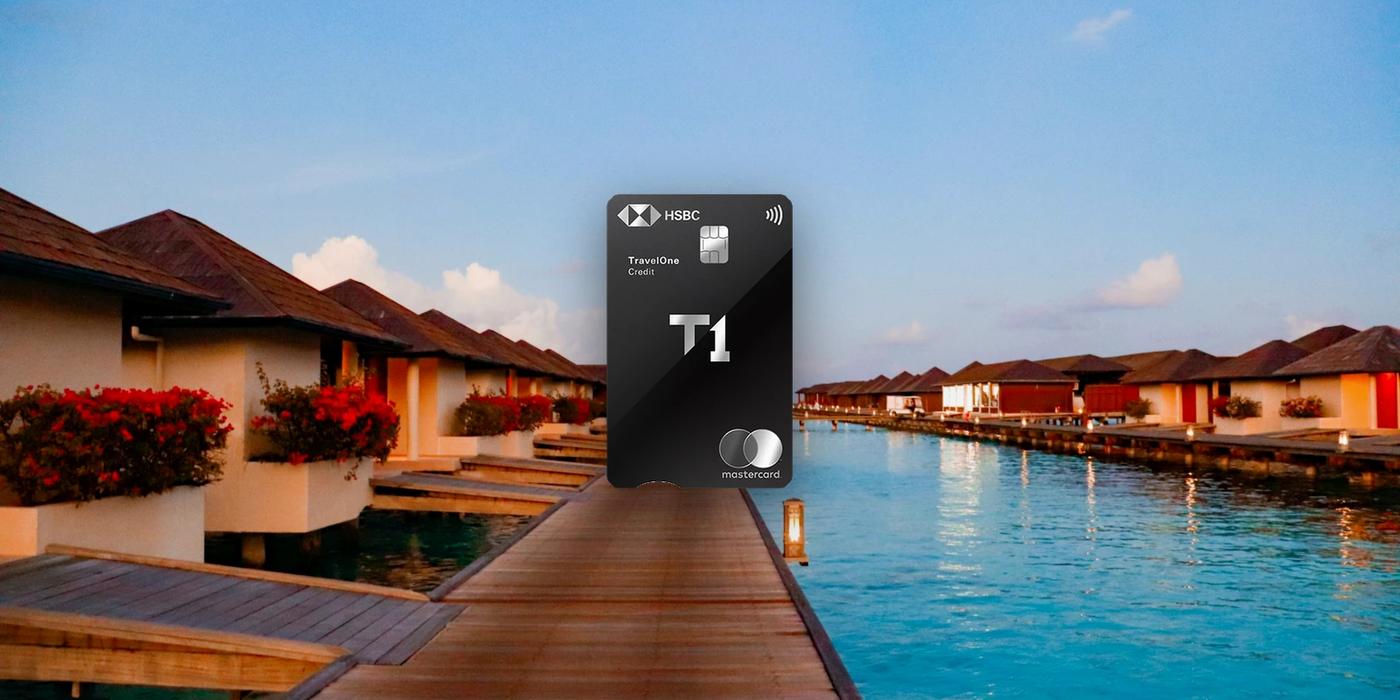
Free transfers into about 20 airlines, plus one of the stronger sign-up bonuses here

| Min income | Base earn | Overseas earn | Transfer fee |
|---|---|---|---|
| S$30,000S$65,000 for foreigners | 1.2 mpdlocal, uncapped | 2.4 mpdforeign currency, uncapped | Freeuntil further notice |
| Partners | Annual fee | Fee returns | Best ratio |
| About 20 airlinesplus 4 hotel programmes | S$196.20waived on S$25,000 spend | Up to 12,000 miles30,000 points on renewal | 25,000 pointsper 10,000 miles |
Almost every write-up of TravelOne opens with the earn rate, decides it is fine, and moves on. That is the wrong end of the card. 1.2 mpd locally is ordinary and 2.4 overseas is good without being remarkable, and neither is the reason to hold it.
The reason is what happens after you earn. Sixteen airline programmes and four hotel ones, twenty in all, and HSBC moves your points to any of them for free. Every other card here charges around S$27 a transfer and makes you save to a block before you can move anything at all.
That turns a balance into something you can actually shop with. When the seat you want is on Qatar rather than Singapore Airlines, you move the points and book it, and it costs you nothing to change your mind. Optionality is the product here.
Annual Fee
S$196.20, waived from year two on S$25,000 of annual spend, and paying it returns up to 12,000 miles.
| Card | First year | Second year on |
|---|---|---|
| Principal card | S$196.20 | Waived on S$25,000 spend |
| What the fee gives back | Nothing | 30,000 points, up to 12,000 miles |
This one has an odd shape: you can spend your way out of the fee, or pay it and get more back than it cost. Paying is usually the better outcome, which makes the S$25,000 waiver an escape hatch rather than a goal.
Worth reading that credit carefully, because 30,000 points is not 12,000 miles for everybody. It is 12,000 if you send it to Asia Miles and 10,000 if you send it to KrisFlyer, which brings us to the section below.
Welcome Bonus
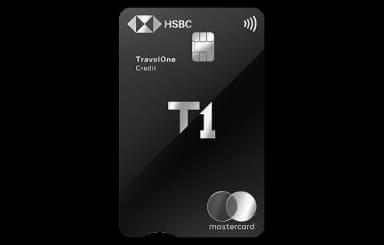
HSBC TravelOne
Welcome bonus: all 2
- 20,000 miles Bonus milesawarded as 50,000 HSBC Reward pointsTransferable to airlines
- S$680 Samsonite ZELTUS 69cm Spinner with built-in scale
No welcome bonus
The last offer we recorded here ran until 2026-10-18. The link still works, but check what is on now before you apply.
Sign-up rewards change often, so confirm the current offer before you apply. New customers only, meaning no card from HSBC in about the last 12 months.
Sign-up offers move monthly and almost always carry a "new to bank" condition, meaning no HSBC card in the past 12 months.
How many miles do I earn?
1.2 miles per dollar locally and 2.4 overseas, with no cap published on either.
| Spend | Rate | Cap |
|---|---|---|
| Foreign currency and overseas | 2.4 mpd | None published |
| Everything else, local | 1.2 mpd | None published |
| Utilities, insurance, education | Nothing | Excluded |
Those rates are quoted at the best partner ratio, which is 25,000 points per 10,000 miles. Send the same points to KrisFlyer and every number in that table drops by a fifth, so 2.4 mpd becomes 2 and 1.2 becomes 1.
HSBC markets both rates as uncapped and I have not found fine print contradicting it, but the absence of a cap is a harder thing to prove than the presence of one. Treat it as very likely rather than certain.
The KrisFlyer Tax
Every other card here charges the same points for a mile wherever it goes. TravelOne does not. Asia Miles and most partners cost 25,000 points per 10,000 miles. KrisFlyer costs 30,000. Same points, same card, a fifth more expensive for the programme most people in Singapore reach for first.
| Destination | Points per 10,000 miles | Miles from 60,000 points |
|---|---|---|
| Asia Miles, Qatar, BA and most others | 25,000 | 24,000 |
| KrisFlyer | 30,000 | 20,000 |
That is 4,000 miles of difference on one transfer, for no reason other than which logo you picked. It is not a trap exactly, HSBC publishes both ratios openly, but it is the kind of thing you only notice if you go looking.
So the honest play is to stop treating KrisFlyer as the default. Cathay through Asia Miles, Qatar and British Airways all reach Singapore comfortably, and on this card they are meaningfully cheaper to reach. If your redemption genuinely has to be on Singapore Airlines, pay the tax knowingly. (Mine mostly does not, which is why this card suits me.)
Transfer ratios are the easiest thing for a bank to change quietly, so check both before you commit to a strategy.
Transfer Partners
This is the best partner list in the country and it is not close: around 20 airline programmes and 4 hotel ones, including KrisFlyer, Asia Miles, British Airways, JAL, Qatar, Turkish, United and Aeroplan.
| Programme | Points for 10,000 miles |
|---|---|
 Cathay Asia Miles Cathay Asia Miles | 25,000 |
 British Airways Avios British Airways Avios | 25,000 |
 EVA Infinity MileageLands EVA Infinity MileageLands | 25,000 |
 Vietnam Airlines Lotusmiles Vietnam Airlines Lotusmiles | 25,000 |
 Air France KLM Flying Blue Air France KLM Flying Blue | 25,000 |
 Etihad Guest Etihad Guest | 25,000 |
 Qantas Frequent Flyer Qantas Frequent Flyer | 25,000 |
 Singapore Airlines KrisFlyer Singapore Airlines KrisFlyer | 30,000 |
 Thai Royal Orchid Plus Thai Royal Orchid Plus | 30,000 |
 Qatar Privilege Club Qatar Privilege Club | 35,000 |
 Turkish Miles&Smiles Turkish Miles&Smiles | 35,000 |
 Air Canada Aeroplan Air Canada Aeroplan | 35,000 |
 JAL Mileage Bank JAL Mileage Bank | 50,000 |
Transfers are free until further notice, which quietly removes the thing that makes every other balance here sticky. On a Citi or UOB card, moving points costs S$27 and forces you to save to a block first, so you tend to commit early and hope. Here you can wait until you have found the seat.
Points expire 36 months from the month they are earned. Three years is generous next to Woman's World at one, and it is not forever: a balance you start building today has to be spent by 2029, and the free transfers mean there is no cost to moving it out early once you know where it is going.
How I actually use it. This is the card I put foreign currency on and the account I leave points sitting in, precisely because moving them later is free. Qatar via the Avios family is where mine usually ends up, which gets me cheaper connections into Europe and Africa than a KrisFlyer redemption would.
Before any redemption, always check the route you want is actually available. The worst thing you can do is diversify into another mileage programme with no redemption in mind.
What should I pair it with?
This is the mirror image of a 4 mpd card. Nothing runs out, but nothing is spectacular either, so TravelOne wins on volume and flexibility rather than on any single transaction. A big overseas month at 2.4 mpd uncapped adds up quickly.
The other thing not to skip: the foreigner income bar here is S$65,000, more than double the S$30,000 for citizens and the highest gap of any card in this lineup. That rules out a lot of people who would otherwise be the ideal holder.
A 4 mpd category card, because 1.2 on local spend is the one genuine weakness.
TravelOne is a good travel card and an ordinary everyday one. What it wants beside it is something that pays properly on the things you buy every week without leaving Singapore.
| The gap | What it costs you | What closes it |
|---|---|---|
| Online shopping | 1.2 mpd where others pay 4 | HSBC Revolution, Citi Rewards |
| Dining and transport | 1.2 mpd | HSBC Revolution |
| Groceries | 1.2 mpd | UOB Preferred Visa |
| Foreign currency at scale | 2.4 mpd is good, not the best | UOB PRVI Miles at 2.4 with a bigger partner gap |

Build your miles card stack
One card never covers everything. Put in what you actually spend and see which cards to hold together, and what to put on each.
Build my stack→The verdict, restated
Judge this on what you can do with the points rather than on how fast they arrive, and it is one of the strongest cards here. Free transfers into about 20 programmes means you never have to guess which airline will have space eighteen months from now, and the renewal credit hands back more than the fee costs. Just do not sleepwalk into KrisFlyer at 30,000 points a block when almost everything else is 25,000.
Sources
HSBC TravelOne product page and card T&Cs, checked 8 July 2026. Earn rates, transfer ratios, the free-transfer policy and the 30,000-point renewal credit correct as of that date. Several things are less certain than the rest and are flagged rather than buried: HSBC markets the earn rates as uncapped but that absence is not confirmed against official fine print; no points expiry is stated on the product page or in the documents read, and the general HSBC rule of about 37 months may apply; the exact exclusion list is not published, so the standard HSBC exclusions are assumed; and no payment-channel condition is published for the foreign currency rate, so it is treated as earning on any channel rather than on an explicit statement to that effect. This guide shares my own experience for education, it is not financial advice, and card terms change: always verify with the bank before applying.