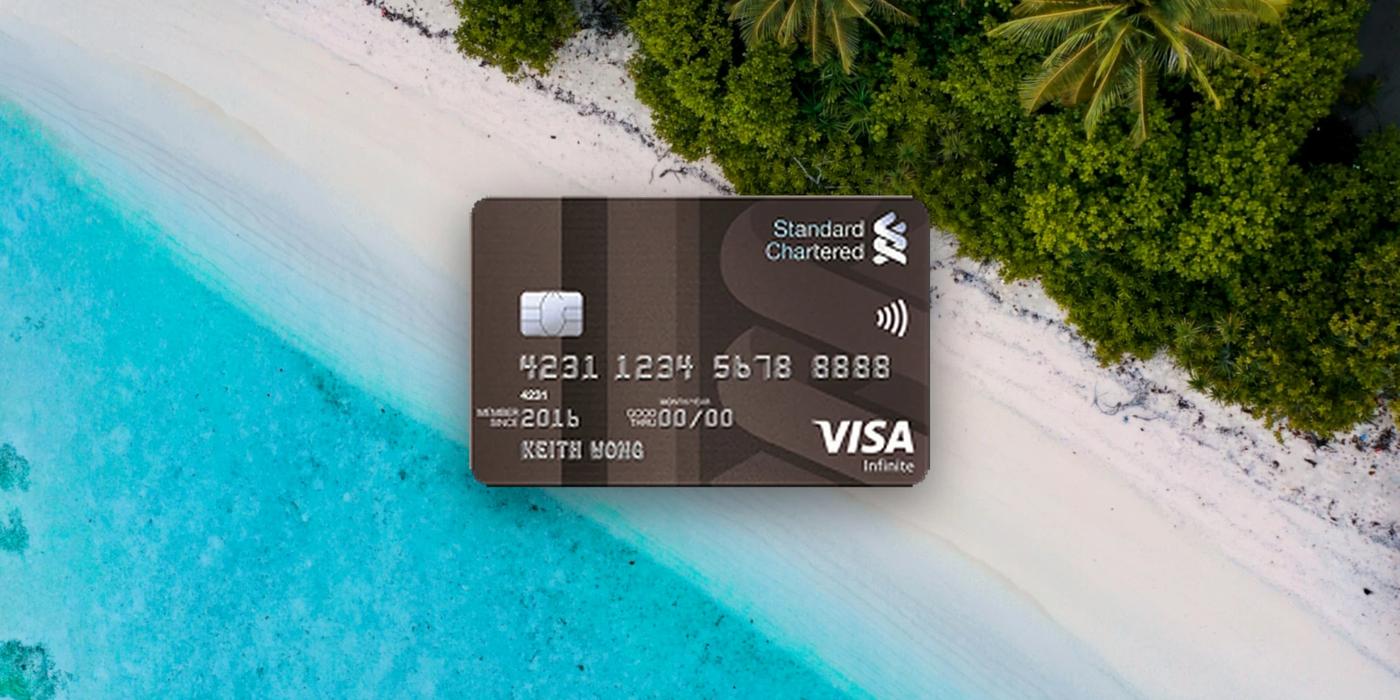
3 mpd overseas uncapped, the best rate here, behind the highest income gate here

| Min income | Base earn | Local earn | Overseas earn |
|---|---|---|---|
| S$150,000the highest gate in this lineup | 1.0 mpdbefore the unlock | 1.4 mpdonce unlocked, uncapped | 3.0 mpduncapped, the best here |
| Unlock | Annual fee | Fee returns | Points expiry |
| S$2,000of spend for the bonus tiers | S$599.50not waivable | Nothingno renewal miles credit | Neverwhile the account is active |
There is exactly one number on this card that nothing else in Singapore matches: 3 miles per dollar on foreign currency, with no cap. UOB PRVI Miles does 2.4 uncapped and is the closest thing to competition. Citi PremierMiles does 2.2. Every 4 mpd card stops paying somewhere around S$1,000 a month.
So on a S$10,000 month abroad this earns 30,000 miles and keeps going. That is the pitch, and if your spending is that shape there is no substitute for it here.
The rest is a question of price. The income floor is S$150,000, the highest of any card on this site, and the S$599.50 fee cannot be waived by any route. It does come back, though: paying it earns 50,000 Rewards Points, worth 20,000 KrisFlyer miles, so the real cost is the gap between the two rather than the sticker.
Annual Fee
S$599.50, not waivable, and nothing is credited back for paying it.
| Card | First year | Second year on |
|---|---|---|
| Principal card | S$599.50 | S$599.50 |
| What the fee gives back | Nothing | Nothing |
This is better than it first looks, and an earlier version of this review had it wrong. Every premium card here gives something back and this one is no exception: Citi Prestige returns 32,000 miles, DBS Vantage 25,000, this card 20,000, and OCBC Voyage 15,000. At two cents a mile that is about S$400 against a S$599.50 fee, so roughly S$200 a year is the true carrying cost, and the rate has to earn back that rather than the whole thing.
The good news is that at 3 mpd it can be. The gap between 3 mpd and the 2.4 you would get on a PRVI Miles is 0.6 miles per dollar, so about S$100,000 of foreign spend a year pays for the fee difference. If you are spending that much abroad, the card is doing real work. If not, it is a fee with a nice rate attached.
Welcome Bonus
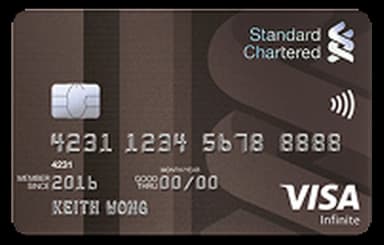
Standard Chartered Visa Infinite
Welcome bonus
- 50,000 miles Welcome milesTransferable to airlines
Offer ends 2027-02-28
Sign-up rewards change often, so confirm the current offer before you apply. New customers only, meaning no card from Standard Chartered in about the last 12 months.
Sign-up offers move monthly and almost always carry a "new to bank" condition, meaning no Standard Chartered card in the past 12 months.
How many miles do I earn?
3 miles per dollar on foreign currency and 1.4 locally, both uncapped, once you have cleared the unlock.
| Spend | Rate | Cap |
|---|---|---|
| Foreign currency and overseas | 3.0 mpd | Uncapped |
| Local, across most categories | 1.4 mpd | Uncapped |
| Before the S$2,000 unlock | 1.0 mpd | Uncapped |
| Utilities, insurance, education | Nothing | Excluded |
The bonus tiers are gated on S$2,000 of spend every statement month, and this is the condition the card lives or dies on rather than a formality. It is not a one-time unlock: miss it in any month and that month pays a flat 1 mpd on everything, foreign currency included, which is what a free card does. A quiet December undoes an expensive card.
3 mpd Overseas, Uncapped
Worth laying this out properly, because "highest uncapped overseas rate" is the kind of claim that sounds like marketing until you see the arithmetic against everything else in the lineup.
| Card | Rate | Miles |
|---|---|---|
| Standard Chartered Visa Infinite | 3.0 mpd | 24,000 |
| UOB PRVI Miles | 2.4 mpd | 19,200 |
| HSBC TravelOne | 2.4 mpd | 19,200 |
| Citi PremierMiles | 2.2 mpd | 17,600 |
| A 4 mpd card capped at S$1,000 | 4 mpd, then base | About 6,800 |
Nearly 5,000 miles a month clear of the nearest rival, on one month. Over a year of that kind of spending it is a wide margin, and it is the only argument this card needs to make.
The honest counterweight is the fee. PRVI Miles on the Amex variant waives its fee at S$50,000 of annual spend and pays 20,000 bonus miles for doing it. So the real comparison is not 3 mpd against 2.4, it is 3 mpd minus S$599.50 against 2.4 mpd plus 20,000 miles and no fee, and that pushes the crossover a long way up.
The absence of an upper limit on the unlocked bonus tier is not confirmed against official fine print, so verify before planning around a very large month.
Transfer Partners
360 Rewards Points convert at 25,000 points per 10,000 miles to both KrisFlyer and Cathay's Asia Miles, and they do not expire while the account is open and active.
| Programme | Points for 10,000 miles |
|---|---|
 Singapore Airlines KrisFlyer Singapore Airlines KrisFlyer | 25,000 |
 Cathay Asia Miles Cathay Asia Miles | 25,000 |
Two partners is better than the Journey card's one and a long way short of the twenty TravelOne reaches. Having Asia Miles alongside KrisFlyer is the meaningful part: Cathay covers a lot of the same region, so a full SIA cabin is no longer the end of the conversation.
No expiry helps here for the same reason it does on Journey. With a narrow partner list, the ability to wait indefinitely for space is what keeps it workable. Redemption requests cost S$27.25 each.
How to use it. This is a card for one very specific spending pattern: large, regular, foreign-currency spending, the kind that comes from working across borders rather than from holidays. For anyone else the fee eats the advantage before the advantage arrives.
Before any redemption, always check the route you want is actually available. The worst thing you can do is diversify into another mileage programme with no redemption in mind.
What should I pair it with?
That gate is the highest here, above the S$120,000 on Citi Prestige, DBS Vantage, HSBC Visa Infinite and OCBC Voyage. Standard Chartered's Priority Banking tiers reportedly lower it, though the published thresholds are approximate rather than exact, so ask rather than assume.
A 4 mpd category card for local spend, because 1.4 mpd at this fee is not a good use of it.
This card has one job. Everything outside foreign currency is ordinary, and at a S$599.50 fee ordinary is expensive.
| The gap | What it costs you | What closes it |
|---|---|---|
| Online shopping | 1.4 mpd where others pay 4 | HSBC Revolution, Citi Rewards |
| Dining and transport | 1.4 mpd | HSBC Revolution |
| Groceries | 1.4 mpd | UOB Preferred Visa |
| No renewal credit | The full S$599.50 every year | Citi Prestige at 32,000 miles, DBS Vantage at 25,000 |

Build your miles card stack
One card never covers everything. Put in what you actually spend and see which cards to hold together, and what to put on each.
Build my stack→The verdict, restated
A single-purpose card that is genuinely the best in Singapore at that purpose. 3 mpd on foreign currency with no ceiling beats everything else here by a clear margin, and if your spending abroad runs to five figures a year the maths works even against a fee that never goes away. Below that, the PRVI Miles Amex at 2.4 mpd with a spend-based waiver and 20,000 bonus miles will leave you better off, and the S$150,000 income gate means most people never have to make the choice.
Sources
Standard Chartered Visa Infinite product page and 360 Rewards T&Cs, checked 8 July 2026. Earn rates, the S$2,000 unlock, the non-waivable S$599.50 fee, the 2.5:1 transfer ratio to KrisFlyer and Asia Miles, and the no-expiry policy correct as of that date. Two things are less certain and are flagged rather than buried: the absence of an upper cap on the unlocked bonus tier is not confirmed against official fine print, and the Priority Banking and Priority Private income thresholds that reportedly lower the S$150,000 gate are approximate figures rather than exact published tiers. The comparison figures for other cards are drawn from their own reviews on this site. This guide shares my own experience for education, it is not financial advice, and card terms change: always verify with the bank before applying.